Posts from the ‘Recordings’ category

Mendelssohn: String Quartets Op. 44, No. 1 and No. 2
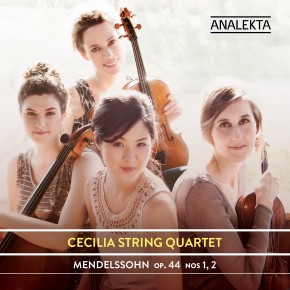
Mendelssohn CD Cover

Mendelssohn: String Quartets Op. 44,
No. 1 and No. 2

Download Album Booklet

Program Notes:

The three quartets of opus 44 are the centrepiece of Felix Mendelssohn’s mature string quartets. He wrote them in the years 1837-38, starting composition at the age of 28, when his fame in the international musical community was rapidly growing. The oratorio St. Paul had recently brought international success. He had directed the renowned Gewandhaus Orchestra in Leipzig since 1835. Now, he travelled constantly between the important musical centres of Europe – conducting, advising major cultural and educational committees, composing commissioned works to order for the major festivals and performing as a pianist, organist and chamber musician for the public and royalty of Europe. Family matters similarly came fast and furious with his wedding to Cécile Jeanrenaud, the daughter of a French Protestant clergyman, in March 1837 and the establishment of a new home in Leipzig.

He began composition of the opus 44 quartets during his honeymoon in the Black Forest and completed the earliest of them, in E minor, on June 18, 1837. The E-flat major quartet followed on February 6 of the following year, the day before the birth of his first son, Carl Wolfgang Paul. The last to be completed, in D major, followed on July 24, 1838. With all three complete, Mendelssohn re-ordered them, giving them the numbering we know today and published the set as Trois Grands Quatuors, with a dedication to the Crown Prince of Sweden.

Mendelssohn held the Quartet in D major, Op. 44, No. 1 in high regard. It was the first of the three to be published but the last to be written. “I have just finished my Quartet in D,” he wrote to the violinist Ferdinand David, a close friend and concertmaster of the Gewandhaus Orchestra. “I like it very much. I hope it may please you as well. I rather think it will, since it is more spirited and seems to me likely to be more grateful to the players than the others.” David and his quartet had already premièred the two earlier opus 44 quartets and now gave the first performance of the D major at one of the quartet’s regular matinées, on February 16, 1839.

The opening movement is an exuberant and high spirited conversation between the four instruments, confidently written and carefully polished. After a period without writing chamber music in the early 1830s, Mendelssohn is now more classically oriented than he was in the earlier, structurally experimental and Beethoven-influenced opus 12 and 13 quartets. The two central movements provide contrast to the quartet’s exuberant start. First comes a gentle, smooth-as-silk Menuetto, somewhat rococo in flavour and in the even structure of its phrases. It is the only minuet in any of Mendelssohn’s quartets. A wistful slow movement follows in which the composer keeps a firm hand on the sentiment. The brilliant finale is a driving saltarello, a whirlwind version of a 16th century dance form that Mendelssohn had already mastered in the final movement of his Italian symphony.

The Quartet in E minor, Op. 44, No. 2, the earliest of the three to be written, opens with a sense of urgency, in Mendelssohn’s favoured key of E minor. Through the agitation, there is a touch of melancholy to the first violin theme. Its arching shape and syncopated accompaniment bear a strong resemblance to the opening of the violin concerto that Mendelssohn was to write in the same key and for the same violinist the following year. (Its opening arching arpeggio phrase also mirrors the opening of the finale of Mozart’s late G minor symphony, but there the similarity ends.) The tautly woven musical ideas of the movement balance the tension of the opening theme with the repose of its second theme. The fertility of invention carries over into the sparkling Scherzo. This is propelled by rhythmic vitality and constantly surprises us with the unexpected. At the same time, everything lies comfortably on the fingerboard – as in the Octet, this is music that is written for those who play as well as for the instruments they play upon. Mendelssohn brings a violinist’s (and viola player’s) inside knowledge to the interplay between the four instruments. “He never touched a string instrument the whole year round,” the composer Ferdinand Hiller once said, “but, when he wanted to play, as with most things in life, he could do it.” The slow movement is a bittersweet song-without words, whose main melody sounds especially eloquent when it reappears on the cello. Any hint of sentimentality – a concern in some of Mendelssohn’s music – is avoided with the composer’s caution not to drag out (nicht schleppend) the movement. The finale again reveals great sophistication in the intricate way Mendelssohn handles bravura material, marrying musical craft with technical virtuosity.

© 2015 Keith Horner
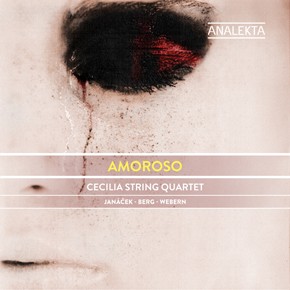
Amoroso: Janáček, Berg, Webern

Amoroso-CD-Cover

Amoroso: Janáček, Berg, Webern

Download Album Booklet


Program Notes:

Love stories – literary, clandestine and youthful – provide an intense background for the three works on this recording, all dating from the first quarter of the last century. Tolstoy’s novella The Kreutzer Sonata provided Czech composer Leoš Janáček with the starting point for the first of his two string quartets. Its tale of passion, jealousy and chamber music is narrated by Pozdnyshev, a jealous and domineering husband, who, suspecting that his wife was having a love affair rather than a musical partnership with a violinist, is driven by jealousy to murder her with a dagger. Janáček identifies with the unnamed wife, rather than with underlying themes in Tolstoy’s polemical narrative: “I had in mind a poor woman, tormented, beaten, battered to death,” he wrote to Kamila Stösslová, his confidante and would-be mistress. He wrote the quartet quickly to an informal commission from the Czech Quartet in 1923, adapting music from an unpublished piano trio based on the same literary source. The poignant, pleading opening theme of the quartet clearly characterizes the victim (and also, apparently, suggests a Moravian folksong that Janáček admired). This theme recurs like a motto in various guises throughout the quartet. The first movement is dominated by a more assertive theme, representing the overbearing husband. The scherzo-like second movement includes the rhythm of a polka and the introduction of the elegant musician, Trukhachevski. In the third movement there is an allusion to Beethoven’s Kreutzer sonata, which was played by the lovers in Tolstoy’s story during a musical soirée. The finale opens with agitated music that represents Pozdynshev’s jealousy. As references to music from earlier movements recur, they are dominated by the poignant, pleading theme of the opening. It is a touching and powerful recollection of the wife as she lies dying.

With the Lyric Suite’s descriptive movement titles – jovial, amorous, mysterious, passionate, delirious and desolate – Viennese composer Alban Berg suggests an underlying program. Musical quotations from Zemlinsky and Tristan und Isolde add fuel to the fire. “Like anyone who commits a perfect crime,” musicologist George Perle wrote, “Berg was proud of his accomplishment and wanted us to know about it.” In the 1960s, Berg’s pupil, theorist Theodor Adorno suggested that the entire suite was a ‘latent opera.’ But it was only in 1977 that it became certain that biographical events had, indeed, driven the very creation of the piece. Perle uncovered an extensively notated score in Berg’s hand, proving that the hidden libretto of Berg’s ‘latent opera’ lay in a real-life, hitherto unsuspected, clandestine love story.

At the heart of all six movements is a fournote musical cell, comprising the notes A-B♭-B♮-F. These are derived from the initials of Berg and Hanna Fuchs-Robettin, wife of an industrialist from Prague, with whom he had a ten-year surreptitious relationship. “I have secretly inserted our initials into the music,” Berg wrote in the notated score he gave to Hanna. “May it be a small monument to a great love.” But this is only the beginning. Most of the score’s 90 pages contain careful annotations, drawn in three different coloured inks. “I have written much that has other meanings into this score for you, to whom, and only for whom every note of this work was written,” he added. The four-note cell is used to determine technical features of the score. To it, Berg added more cryptographic and numerological procedures. “Every movement is related to our numbers: 10 and 23,” he wrote, referring to the number (23) he believed governed his own destiny, and 10, Hanna’s number. These are crucial to the structure of the piece. Berg himself viewed the path of the Lyric Suite, one of his most acclaimed works, as “the large unfolding…of an overall programmatic concept: ‘Subjection to Fate.’”

In 1905, Austrian composer Anton Webern was head-over-heels in love with his cousin, Wilhelmine Mörtl, with whom he took a walking vacation to Lower Austria, just west of Vienna. The 21 year-old composer wrote effusive diary entries about their idyllic time together (‘a fairyland’…‘floods of gold’…‘a forest symphony’…‘two souls had wed’). Webern composed the lushly romantic Langsamer Satz in Vienna that summer, having almost completed the first of four years of intensive private composition studies with Schoenberg, concurrent with doctoral studies in musicology at the University of Vienna. It was one of well over 100 finished and sketched student compositions and exercises that he would complete during his time with Schoenberg, most of it remaining unpublished. This single movement, published 1965, with a tripartite A-B-A structure plus coda, inhabits the intense, nocturnal, emotionally charged landscape of his teacher’s Verklärte Nacht of six years earlier. Its polyphonic lines reveal a close study of Brahms, while the intoxicating, last-gasp, late romantic harmonies are a path that Webern would soon leave behind. Of his chosen medium for this love song, Webern was shortly to write to his brother-in-law: “Quartet playing is the most glorious music-making there is.”

Notes © 2013 Keith Horner
Comments welcomed: khnotes@sympatico.ca

Dvořák: Quartet Op. 106, 6 Cypresses, 2 Waltzes

Dvorak-CD-cover

Dvořák: Quartet Op. 106,
6 Cypresses, 2 Waltzes

Download Album Booklet

Program Notes:

Dvořák spent Christmas 1895 at his country home at Vysoká, just outside Prague. He was working confidently and had already completed the String Quartet in G, B.192, Op. 106, his thirteenth quartet, over a four-week period, in November and early December. He spent Christmas Day putting the final touches to yet another quartet and just five days later, this quartet, too, was finished. Dvořák had composed two of his finest quartets in less than two months. However, the ease and pleasure with which he created them came after a period when the ink had run dry.

Behind him was a second visit to the United States. Artistically, it had been a success. He could look back with pride on the new cello concerto, the New World Symphony, the American String Quartet and more. But Dvořák had felt cut off from his friends and relatives. He had been isolated from the Bohemian countryside and from a life that provided inspiration for his creativity. “Oh, if only I were home again!” the homesick Dvořák had written from New York. He and his wife returned to Bohemia for good in the spring of 1895. Once back in familiar surroundings, Dvořák resumed his former ambition, and one of the composer’s finest string quartet movements. A busy and vigorous Scherzo follows, Mendelssohn like at times, but with a touch of country earthiness. The finale begins exuberantly but includes wistful, somewhat nostalgic music in its pages. It also brings in echoes of the opening movement before being swept along to an affirmative, joyful conclusion.

The two Waltzes, B.105, Op. 54 started life in 1879, with a request for dance music for a ball organised by the Národní Beseda, a patriotic organisation in Prague. Dvořák and other leading composers, including Smetana and Fibich, were each asked to provide a series of linked waltzes. Dvorák soon realized, however, that his waltzes were more appropriate to concert or salon performance than dancing, so he composed an altogether new set of dances for the ball called Prague Waltzes. He then re-worked the original music into a set of eight waltzes for piano and arranged the two most popular movements for strings. The first is a gently rocking and distinctly Czech waltz, with faster-paced episodes. The Allegro vivace has the character of one of Dvořák’s Slavonic Dances.

© Keith Horner

Karin Kei Nagano with Cecilia String Quartet: Mozart Piano Concertos Nos. 12 and 13

Nagano-Cecilia-Album-Cover

Mozart: Piano Concertos Nos. 12 & 13

Download Album Booklet

Program Notes:

This pair of attractive and highly crafted piano concertos from 1782 are among the first such works Mozart composed after moving from Salzburg to Vienna in order to pursue his career as an independent artist. The woodwind parts are not structurally essential in these concertos, and Mozart himself authorized performances of the pieces a quattro, by a pianist with string quartet accompaniment, as in the present recording. What is thereby lost in sheer volume of sound can be gained through nuance, and these pieces are very effectively conveyed in the more intimate context of chamber music.

Particularly memorable is the Andante of K. 414, with its sublime, hymn-like main theme, which seems to quote Johann Christian Bach’s overture for the revival of Baldassare Galuppi’s opera La calamità dei cuori (The calamity of love). J.C. Bach had already befriended the Mozart family during their time in London in 1764, when Wolfgang was eight years old; several years later, around 1770, the young Mozart made transcriptions of three of J.C. Bach’s keyboard sonatas, turning these works into the concertos K. 107. In addition to devising orchestral ritornellos in these arrangements, Mozart sometimes adds and deletes from his models and approximates, in these early works, the general proportions of his later concerto form. The cradle of Mozart’s concerto composition thus lay in his transformation of the sonata, a genre associated with private-home performance, into the more public-display genre of the concerto, in which he himself assumed the role of virtuoso. In this context, we can surmise that Mozart’s allusion to J.C. Bach in K. 414 represents a meaningful homage to the older master, who had died shortly before, in January 1782.

The first two movements of K. 414 are thematically related, and the continuation of the orchestral ritornello of the Andante beginning at measure 9 recalls the beginning of the main theme of the first movement of K. 414, with its rise by thirds through the A major tonic triad followed by a stepwise descent. Various themes in this delightful concerto employ such scalar descending figures. Already in the second phrase of the first movement, for instance, Mozart enlarges the scalar descent through an octave from measure 2 as a rhythmically broadened, syncopated descent in measures 5-8, an idea that forms the gestural climax of the opening theme. The prominence in the development of this Allegro of the key of F-sharp minor foreshadows Mozart’s later Concerto in this key, K. 488. In the charming Allegretto finale, the stepwise descending motion characteristic of the earlier movements is balanced by a rising melodic impetus.

The Concerto in C Major, K. 415, also displays such motivic interconnections between its movements. The sweeping conjunct motion beginning on C in the opening march-like Allegro reappears transformed in the gliding lyrical contour of the Andante in F major, a movement that conveys a strikingly operatic character. The opening melody of this Andante is shaped around C, the dominant, and unfolds as a series of increasingly passionate descending gestures to this note from D, from F, and from A. Then comes the melodic crux: a soaring upward leap through a tenth to the highest note, B-flat, a gesture then balanced by a long lyrical descent, leading to the end of the theme. This opening melody is beautifully shaped, and the movement displays other subtle features, such as the chains of trills that appear before the reprise and in the coda.

A rejected sketch for this slow movement shows that Mozart contemplated using a very different theme in C minor, whose descending contour closely parallels the main subject of the jovial finale, in C major and 6/8 time. While discarding this idea for the slow movement, he introduced a pair of pathos-laden Adagio episodes into the Allegro finale, in mm. 49-64 and 216-231. A return of the 6/8 tune dispels the melancholy C-minor music, but the work ends gently, with a decrescendo to pianissimo in the final moments. K. 415 was first performed at Mozart’s academy concert on March 23, 1783, together with the “Haffner” Symphony, K. 385, in the presence of Austrian Emperor Joseph II.

In a letter to his father in Salzburg, Mozart described these concertos from 1782 as “a happy medium between what is too easy and too difficult; they are very brilliant, pleasing to the ear, and natural, without being vapid. There are passages here and there from which the connoisseurs alone can derive satisfaction; but these passages are written in such a way that the less learned cannot fail to be pleased, though without knowing why.” Mozart’s “happy medium” thus seeks to avoid empty virtuosity as well as mere complexity; in his view, intricate passages “cannot fail to please” the “less learned.” His regard for the overall impact of his music on relatively untutored listeners was an enduring concern. This ingratiating music is at once refined and transparent, innovative yet accessible.

© William Kinderman
William Kinderman is the author of many books on music, including Mozart’s Piano Music, Beethoven, and Wagner’s ‘Parsifal’, all published by Oxford University Press.